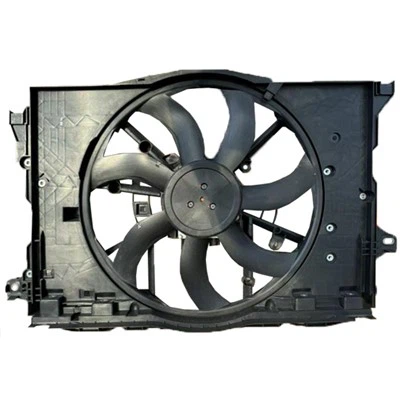
Want the best cooling for your engine? It starts with the fan. So, what's the most effective cooling fan?
The most effective cooling fan depends on your vehicle and needs. Electric fans are often more efficient and offer better control. But, mechanical fans can be more reliable in certain situations. Consider your engine type and driving conditions.

Want to know more about cooling fans? Let's dive into what makes a fan effective.
What are the different types of engine cooling fans?
Not all cooling fans are the same. There are different kinds. So, what types of cooling fans are there?
There are two main types: mechanical and electric. Mechanical fans are driven by the engine. Electric fans are powered by the car's electrical system. Each type has its own pros and cons for engine cooling.

Understanding the different types of engine cooling fans is crucial for choosing the right one for your vehicle. Mechanical fans are the traditional type of cooling fan. They are attached to the engine's crankshaft and driven by a belt. Mechanical fans are simple and reliable, but they can be less efficient than electric fans.
Electric fans, on the other hand, are powered by the car's electrical system. They are typically mounted in front of or behind the radiator and are controlled by a temperature sensor. Electric fans are more efficient than mechanical fans because they only run when needed. This can improve fuel economy and reduce engine noise.
Within each type, there are also variations. Mechanical fans can have different numbers of blades and different blade designs. Electric fans can be single-speed or variable-speed. Variable-speed fans can adjust their speed based on the engine's temperature, providing more precise cooling.
Here's a table summarizing the different types of engine cooling fans:
| Type | Description | Pros | Cons |
|---|---|---|---|
| Mechanical | Driven by engine's crankshaft | Simple, reliable | Less efficient, constant drag |
| Electric | Powered by car's electrical system | More efficient, better control | More complex, relies on electrical system |
What is the difference between a radiator fan and a cooling fan?
Are "radiator fan" and "cooling fan" the same thing? It can be confusing. So, what's the difference?
The terms are often used interchangeably. A radiator fan is a type of cooling fan. It pulls air through the radiator to cool the engine coolant. So, a radiator fan is a specific type of cooling fan.

While the terms "radiator fan" and "cooling fan" are often used interchangeably, there is a subtle difference between them. A cooling fan is a general term for any fan that is used to cool something down. A radiator fan, on the other hand, is a specific type of cooling fan that is used to cool the engine coolant in a car's radiator.
The radiator is a heat exchanger that transfers heat from the engine coolant to the air. As the coolant flows through the radiator, it is cooled by the air passing over it. The radiator fan helps to draw air through the radiator, especially when the car is idling or moving slowly.
In most cars, the radiator fan is located in front of or behind the radiator. It is typically an electric fan that is controlled by a temperature sensor. When the engine coolant reaches a certain temperature, the temperature sensor activates the fan, causing it to turn on and draw air through the radiator.
What tells the radiator fan to kick on?
What makes the fan start spinning? Is it magic? So, what triggers the radiator fan?
A temperature sensor tells the radiator fan to turn on. This sensor monitors the engine coolant temperature. When the coolant reaches a certain temperature, the sensor signals the fan to start cooling the engine.

The temperature sensor is the key component that tells the radiator fan when to turn on. This sensor is typically located in the engine block or in the radiator itself. It monitors the temperature of the engine coolant and sends a signal to the car's computer or to a relay that controls the fan.
When the coolant temperature reaches a certain threshold, typically around 200-220 degrees Fahrenheit, the temperature sensor 1sends a signal that activates the fan. The fan then starts spinning, drawing air through the radiator and cooling the coolant.
[1]Understanding how a temperature sensor functions can help you diagnose issues with your vehicle's cooling system effectively.
The temperature sensor is designed to be accurate and reliable. However, it can fail over time, causing the fan to turn on too early or too late. If the fan is running constantly, even when the engine is cold, it could be a sign that the temperature sensor is faulty.
Here's a table summarizing the process:
| Step | Description |
|---|---|
| 1. Temperature Rises | Engine coolant heats up as the engine runs |
| 2. Sensor Detects Heat | Temperature sensor monitors coolant temp |
| 3. Signal Sent | Sensor sends a signal when the threshold is reached |
| 4. Fan Activates | The signal triggers the radiator fan to turn on |
Conclusion
Effective cooling fans are vital. Know the types, understand the sensor, and choose what fits your car. This keeps your engine running cool.