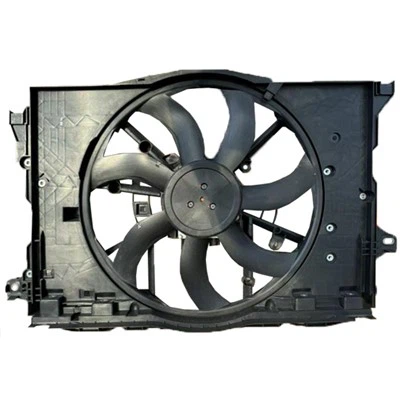
The radiator cooling fan has always been a critical component of automotive thermal management. Its job is simple in principle-move air through the radiator to dissipate heat-but the technology behind it has evolved significantly over the past century.
From early engine-driven mechanical fans to modern electronically controlled electric cooling fans, each stage of development has been shaped by changing vehicle designs, fuel efficiency requirements, and advances in electronics.
Understanding this evolution helps distributors, repair professionals, and automotive engineers appreciate how cooling fan technology has improved in efficiency, reliability, and control.

Early Mechanical Cooling Fans (1900s–1970s)
In the early decades of automotive development, cooling fans were directly driven by the engine.
A mechanical fan was mounted on the water pump shaft or crankshaft pulley and rotated whenever the engine was running. The faster the engine turned, the faster the fan spun.
This design was simple and reliable, but it had several limitations:
The fan consumed engine power even when cooling was not needed
Cooling efficiency depended entirely on engine speed
Noise levels were relatively high
Fuel efficiency was reduced due to constant mechanical load
At highway speeds, airflow generated by vehicle movement was often sufficient for cooling, yet the mechanical fan continued spinning, wasting energy.
Despite these drawbacks, mechanical fans remained widely used for decades because they were durable and easy to manufacture.
The Introduction of Clutch Fans (1970s–1990s)
To improve efficiency, automakers introduced viscous clutch fans in the 1970s.
A clutch fan uses a temperature-sensitive fluid coupling that allows the fan to engage only when cooling is required.
When the engine temperature rises:
the viscous clutch locks
the fan spins with the engine
airflow increases through the radiator
When the engine temperature drops:
the clutch partially disengages
the fan slows down
This innovation significantly improved fuel efficiency and reduced unnecessary fan operation.
Clutch fans became especially common in rear-wheel-drive vehicles, trucks, and SUVs, where larger engines required stronger cooling capacity.
However, clutch systems still relied on engine power and had limited control precision compared with modern electronic systems.
The Shift to Electric Cooling Fans (1990s–Present)
As vehicle technology advanced, manufacturers increasingly adopted electric radiator fans.
Unlike mechanical systems, electric fans are powered by electric motors controlled by the engine control unit (ECU).
The ECU activates the fan based on inputs from sensors such as:
coolant temperature
air conditioning pressure
vehicle speed
Electric fans offer several advantages:
Improved Fuel Efficiency
Because electric fans operate only when needed, they eliminate the constant mechanical load on the engine.
More Precise Cooling Control
The ECU can activate the fan at specific temperature thresholds, improving engine temperature management.
Better Packaging Flexibility
Electric fans are not tied to engine speed or pulley placement, allowing more flexibility in engine compartment design.
Reduced Noise
Modern electric fans use optimized blade designs and balanced motors, resulting in quieter operation.
These advantages led electric fans to become the standard solution for most modern passenger vehicles.
Modern Cooling Fan Technologies
Today's automotive cooling systems are far more advanced than early mechanical designs.
Modern vehicles may use:
Multi-Speed Electric Fans
Fans can operate at different speeds depending on cooling demand.
PWM-Controlled Motors
Pulse-width modulation (PWM) allows precise control of fan speed and power consumption.
Brushless Fan Motors
Brushless motors offer longer service life, improved efficiency, and reduced electrical noise.
Integrated Cooling Modules
In many modern vehicles, radiator fans are part of complete cooling modules that include the radiator, condenser, and shroud assembly.
These developments are driven by stricter emissions regulations, fuel efficiency requirements, and increased engine power density.
Cooling Fans in Hybrid and Electric Vehicles
The transition toward hybrid and electric vehicles is further transforming cooling system design.
Although electric vehicles do not have traditional internal combustion engines, they still require thermal management for:
battery packs
power electronics
electric drive systems
Cooling fans continue to play an important role in maintaining safe operating temperatures in these systems.
As EV technology advances, thermal management solutions-including cooling fans-are becoming increasingly sophisticated.
A Century of Cooling Innovation
The evolution of automotive cooling fans reflects broader changes in vehicle engineering. What began as a simple mechanical device has developed into a precisely controlled component within modern thermal management systems.
Today's radiator fan assemblies combine aerodynamic design, electric motor technology, and electronic control systems to deliver reliable cooling under a wide range of operating conditions.
For distributors and repair professionals, understanding this evolution helps explain why modern cooling fans are more efficient, quieter, and more durable than earlier designs.
A Note from the Manufacturer
At Hongjiang Electric, we focus on the design and manufacturing of automotive radiator cooling fan assemblies for the global aftermarket.
Our products incorporate modern fan technologies such as:
optimized blade aerodynamics
high-precision motor balancing
brush and brushless motor options
durability testing for long service life
By combining proven design principles with modern manufacturing processes, we support distributors and repair professionals with reliable cooling fan solutions.
👉 For a deeper look at how radiator fans move through the global supply chain, see our related guide:
Global Radiator Fan Supply Chain: How Cooling Fans Move from Factory to Aftermarket