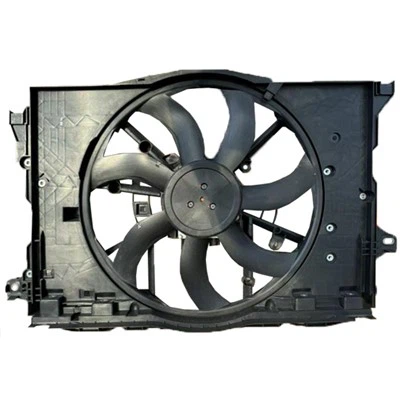
When buyers look at different radiator fan assemblies-some with 4 blades, others with 7, 9, or even 10 blades-it's natural to wonder: Why are they designed so differently? Is it just a matter of style, or does blade count reveal something about performance and engineering?
In reality, blade number is a deliberate choice made by automotive engineers. It affects airflow, noise, motor load, cost, and even the thermal strategy of the entire powertrain system. Here's the clear explanation your workshop, sourcing team, or aftermarket business can rely on.
Different Engines Have Different Cooling Needs
A 1.5L compact sedan and a 4.0L SUV obviously don't generate the same amount of heat.
So the fan systems are designed accordingly:
Small passenger cars: 4–6 blades are usually enough
SUVs, pickups, V6/V8 engines: 7–10 blades to provide higher airflow
EV/Hybrid models: often 9–11 blades due to complex thermal management
More blades = more airflow (CFM) under the same motor power.
Blade Count Controls Noise Levels (NVH)
More blades push more air-but also create more noise.
Therefore:
Family cars prioritize quietness → 6–7 blades
High-power vehicles accept more noise → 8–10 blades
Modern OEM fans go through strict NVH validation, which naturally dictates blade count and shape.
Aerodynamics and Fan Size Also Matter
Engineers balance:
Rotor diameter
Shroud size
Blade pitch angle
Fan speed
Motor torque
A small-diameter fan may need more blades to generate enough airflow.
A large-diameter fan can achieve the same with fewer blades.
It's always a system-level engineering decision.
EV and Hybrid Cars Use More Blades
Why?
Because they need to cool:
the engine (if hybrid)
the traction motor
the inverter
the battery thermal loop
the AC condenser
EV fans must move high airflow with lower noise, so engineers use:
More blades
More curved, narrow, high-pitch profiles
Brushless motors (BLDC) for quieter, smoother operation
That's why newer Toyota, Honda, and Chinese NEV models often use 9–11 blades.

Cost and Materials Are Also Factors
More blades = higher cost (material + mold + motor load).
So OEMs keep costs optimized depending on the segment:
| Car Type | Typical Blade Count | Reason |
|---|---|---|
| Economy cars | 4–6 | Low heat load, cost-sensitive |
| Mid-size sedans | 6–7 | Balance of airflow & quietness |
| SUVs / Pickups | 8–10 | High airflow needed |
| EV / Hybrid | 9–11 | High airflow & low noise required |
Summary: What Blade Count Really Means
| Feature | Fewer Blades (4–6) | More Blades (7–10+) |
|---|---|---|
| Airflow | ⭐⭐ | ⭐⭐⭐⭐ |
| Noise | ⭐⭐⭐ | ⭐⭐ |
| Motor Load | Low | Higher |
| Cost | Lower | Higher |
| Application | Compact cars | SUVs, EVs, hybrids |
Different blade counts exist because different vehicles-and different powertrains-need different cooling strategies.
Which Fan Type Should You Source for Your Market?
If you supply parts for:
compact sedans → 4–6 blade units are usually correct
mid-size sedans (e.g., Toyota Camry) → 6–7 blade designs
SUVs & pickups → 8–10 blade assemblies
EV/Hybrid → 9–11 blade BLDC systems
Choosing the right blade count ensures compatibility, airflow, and noise control-all critical for customer satisfaction and reduced returns.
Hongjiang Electric - A Specialist in OEM-Grade Radiator Fan Assemblies
As a professional manufacturer, we produce both:
Brush-type radiator fan assemblies
Brushless (BLDC) radiator fan assemblies
What stands out:
OE-matched performance
Stable quality for high-mileage climates
Flexible MOQs for distributors
If you're sourcing reliable radiator fan assemblies from China, talk to us-we support passenger car aftermarket distributors across the US, Middle East, Europe, and Latin America.