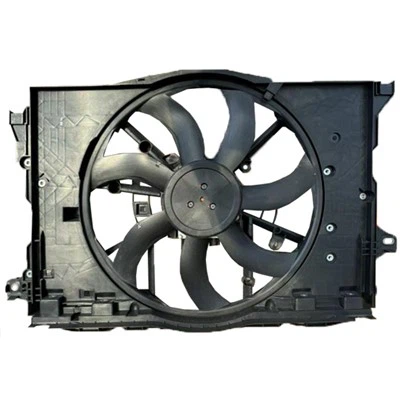
Understanding why aftermarket radiator fans fail helps distributors, importers, and workshop chains reduce warranty claims, protect their reputation, and choose the right manufacturing partners.
1. Inferior Motor Design and Component Quality
The fan motor is the heart of any cooling fan assembly. One of the most common causes of failure is the use of:
Low-grade copper windings
Inconsistent commutator quality (in brushed motors)
Poor bearing selection or lubrication
These shortcuts may reduce upfront cost but often lead to early motor burnout, noise issues, or intermittent operation - especially in high-temperature or stop-and-go driving conditions.
Professional buyers should look beyond appearance and focus on motor durability standards.
2. Poor Rotor Balancing Leading to Vibration
Even small imbalances in the rotor can create vibration during operation. Over time, this vibration can:
Accelerate bearing wear
Crack fan blades or shrouds
Increase noise complaints
Shorten overall service life
Inconsistent balancing is a common issue in low-cost aftermarket products where dynamic balancing is skipped to save time.
3. Substandard Fan Blade Materials
Fan blades are exposed to constant heat cycles, airflow stress, and vibration. Failures often occur when blades are made from:
Recycled plastics with inconsistent strength
Materials without heat-aging resistance
Designs that lack structural reinforcement
High-quality aftermarket assemblies typically use PA66 reinforced with glass fiber, which maintains strength and dimensional stability under prolonged heat exposure.
4. Incorrect Application or Fitment Matching
Another frequent cause of failure is not the product itself, but incorrect application.
Examples include:
Installing a fan with insufficient airflow (CFM) for the engine size
Using a fan designed for a different engine or radiator layout
Connector or control mismatches causing electrical stress
This is why accurate OEM reference matching and vehicle application verification are essential in aftermarket sourcing.
5. Inadequate Thermal and Durability Testing
Some aftermarket fans pass initial functional checks but fail prematurely due to lack of testing under real operating conditions.
Commonly skipped tests include:
High-temperature endurance testing
Long-cycle durability testing
Noise and vibration evaluation under load
Without these validations, early failures are more likely once the fan is exposed to daily driving conditions.
6. Electrical System Compatibility Issues
Modern vehicles rely heavily on electronic control modules. Incompatible motors or poorly designed control interfaces can result in:
Overcurrent conditions
Erratic fan operation
Premature electronic failure
This is especially critical for newer platforms and vehicles using variable-speed or brushless fan systems.
How Professional Buyers Can Reduce Aftermarket Fan Failures
From a sourcing perspective, most failures can be avoided by focusing on process, not just price.
Experienced buyers typically prioritize suppliers who offer:
OEM-structure-based design
Controlled material selection
Precision rotor balancing
Multi-stage performance testing
Clear application and OEM reference data
Our Approach as a Radiator Fan Assembly Manufacturer
At Hongjiang Electric, our radiator cooling fan assemblies are developed based on OEM architecture and validated through structured testing processes.
We focus on:
Stable motor performance
Reinforced fan blade materials
Controlled balancing standards
Application-specific fitment verification
This approach helps distributors and aftermarket partners reduce returns, warranty claims, and long-term sourcing risk - especially in high-temperature and high-mileage markets.
Final Thoughts
Aftermarket radiator fan failures are rarely accidental. In most cases, they reflect compromises made during design, materials selection, or validation.
For professional buyers, understanding these failure points is the first step toward building a more reliable product line and protecting downstream customers.
If you are evaluating aftermarket cooling fan suppliers or planning to upgrade your current offering, choosing a manufacturer with proven engineering discipline can make all the difference.
👉 Contact our team to discuss your market requirements or specific applications.