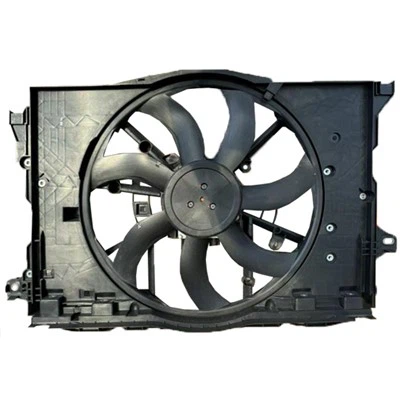
When replacing a cooling fan assembly, one of the most common - and often misunderstood - questions is whether the fan is a "pull" type or a "push" type.Understanding the difference is essential to ensure proper airflow direction, cooling efficiency, and engine safety.
What's the Difference Between Pull and Push Type Fans?
A pull-type fan is mounted behind the radiator (engine side) and pulls air through the radiator core.
A push-type fan, on the other hand, is mounted in front of the radiator (grille side) and pushes air through the core.
🔹 Pull type = suction direction → engine side (most common in passenger vehicles)
🔹 Push type = pressure direction → front-mounted auxiliary or AC condenser fans
Airflow direction matters because a reversed installation will reduce cooling efficiency or even overheat the engine, especially under load.
Why Most Vehicles Use Pull-Type Fans?
In modern passenger cars, nearly all OE designs use pull-type assemblies.
This design provides:
Better airflow through the radiator and condenser
Quieter operation (fan shroud helps reduce noise)
Easier control via electronic fan relays and temperature sensors
By contrast, push-type fans are more often found in:
Vehicles with limited rear clearance (e.g., sports cars)
Auxiliary fans for air-conditioning systems
Off-road or agricultural machines, where the cooling module layout differs
| Installation Position | Airflow Type | Correct Setup |
|---|---|---|
| Behind the radiator (engine side) | Pull type | Fan should pull air through the radiator |
| In front of the radiator (grille side) | Push type | Fan should push air through the radiator |
If the wiring polarity is reversed, the fan will spin the wrong way - reducing efficiency.
What Technicians Often Get Wrong (Real Examples)
Even seasoned mechanics can get confused when replacing aftermarket fans - especially universal motors or front-mounted assemblies.
In a discussion from the Subaru Mechanics Forum (Facebook), one technician shared:
"I replaced the fan on a 2014 Impreza but it still overheats - I didn't realize the fan I installed was pushing air the wrong way."
Dozens of replies followed, many echoing similar experiences:
sometimes the fan physically fits, but the airflow direction or polarity is reversed.
The root cause? Universal fans don't come with a pre-installed connector, so the polarity can be wired in either direction - making it easy to accidentally reverse the airflow.
(Reference: Community discussion, Subaru Mechanics Group, Facebook, 2021.)
This type of confusion is even more common when switching from OE assemblies to aftermarket universal kits, especially in DIY repairs.
Universal Fan Motors: Wiring and Airflow Direction
As Carparts explains in its blog:
"Universal fan motors won't have a connector and need to be wired so that the fan is pulling air through the radiator rather than pushing air through it, unless the fan is an aftermarket fan mounted on the front side."
That means when installing a universal motor:
- Confirm the mounting side (front or rear of radiator)
- Test the airflow direction before final installation
- Reverse polarity if the air is flowing in the wrong direction
Differences Between Passenger Cars and Heavy Equipment
The concept of pull vs push applies differently in non-passenger vehicles.
For example:
Tractors, excavators, and forklifts often use reversible or front-mounted push fans to prevent dust buildup or handle bi-directional air paths.
Compact cars or hybrids almost exclusively use pull-type fans for compact packaging and noise control.
Understanding the operating environment - not just the airflow direction - helps select the right fan type for each application.
Whether you're replacing an OE fan assembly or installing a universal fan motor, always verify:
Mounting position (front vs rear)
Airflow direction (push or pull)
Electrical polarity (for universal types)
A correctly oriented fan is critical for cooling performance, and even a small wiring mistake can make a big difference.
As many technicians have learned the hard way - a fan that spins the wrong way is worse than no fan at all.
Why OE-Fit Assemblies Are Easier?
Aftermarket manufacturers like Hongjiang Electric design fans to match OE specifications, meaning:
Pre-wired connectors (no need for manual wiring)
Correct rotation and airflow direction built in
Tested balance between motor speed and blade angle
These plug-and-play assemblies eliminate installation errors and ensure stable cooling performance, especially for workshops or distributors handling volume orders.