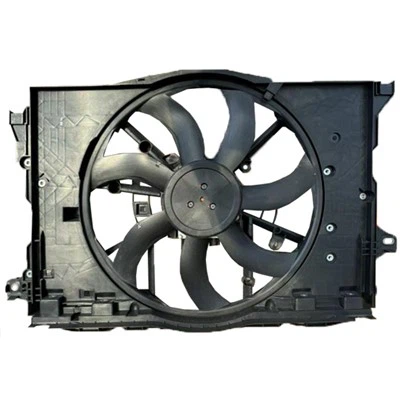
In today's automotive aftermarket, one marketing phrase appears everywhere:
"We fix the flaws of OE parts - our product is better than OE."

It sounds impressive.
It helps vendors justify their pricing.
But is it technically accurate?
Not always.
And in some cases, not even close.
As a manufacturer with 20+ years of experience producing radiator fan assemblies for global distributors, we want to clarify what's real and what's marketing fiction - because the industry deserves more honesty.
Can aftermarket manufacturers truly fix OE weaknesses?
Yes - but only in specific, limited scenarios.**
It is possible to improve certain points where OE designs have shown weaknesses after years of use:
✔ Real-world issues where aftermarket engineers can optimize:
OE shrouds becoming brittle due to aging → using higher-grade PA66+GF30
OE fan motors wearing out early → upgrading brushes, bearings, or insulation
OE noise issues → optimizing blade angle or airflow modeling
OE discontinued parts → redesigning for longer lifespan
These changes are legitimate engineering improvements, based on real market feedback.
BUT -
❌ It does not mean the aftermarket version is "better than OE" overall.
It only means specific weaknesses were reinforced.
What OE still does better (and no aftermarket can replace)
OE manufacturers operate at the vehicle-system level.
They have access to:
full vehicle NVH calibration
thermal & airflow CFD matched to engine bay
thousands of hours of life-cycle testing
ECU PWM integration data
cross-department test benches (engineers + thermal teams + suppliers)
Aftermarket factories - even the best - simply do not have full access to vehicle-level engineering specifications.
So, any claim like:
"Our fan is better engineered than OE."
or
"We fixed everything the OE did wrong."
…is a technical exaggeration at best.
Why do some vendors still boldly make this claim?
Because it sounds good.
Because customers like the idea of "better performance at lower price."
Because most buyers cannot easily verify the truth.
But the reality is:
Many such claims are based only on one or two anecdotal improvements - not full-system superiority.
And in some cases, factories simply copy OE designs without real modification.
The honest truth: where aftermarket adds real value
Aftermarket manufacturers provide benefits OE cannot:
Better availability when OE stocks out
Lower price for repair shops and distributors
Faster delivery & flexible MOQs
Ability to integrate market feedback directly
Localized improvements on known weak points
This is the real value of the aftermarket - and it is strong enough on its own.
No need for exaggerated slogans.
Our philosophy: engineering honesty over empty marketing
At Hongjiang Electric, we do not claim "we outperform OE on everything."
Instead, we commit to:
✔ Reinforcing known OE weak points
✔ Following OE specifications faithfully
✔ Maintaining strict quality and durability standards
✔ Providing reliable alternatives at sustainable pricing
✔ Being transparent about the engineering reality
This is how real trust is built with distributors, wholesalers, and workshop partners around the world.
Conclusion
The aftermarket does not exist to "beat OE."
It exists to:
offer reliable replacements
fill gaps OE cannot cover
solve cost and supply challenges
improve known field issues when possible
So the next time you see a bold claim like:
"Our fan is better than OE."
Take it with a grain of engineering salt - and ask for real evidence.