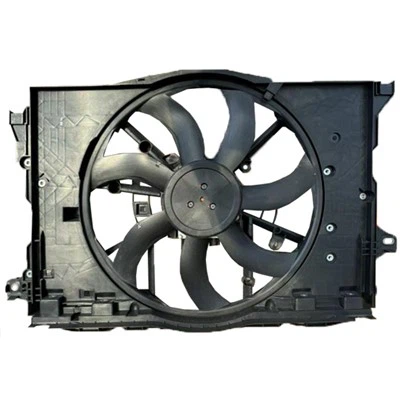
Radiator cooling fans are essential components of modern automotive thermal management systems. Their primary function is to move air through the radiator to dissipate heat from the engine coolant.
However, the design of radiator fans varies significantly between passenger cars and commercial vehicles such as trucks, buses, and heavy-duty machinery. These differences are driven by variations in engine size, operating conditions, and cooling demands.
Understanding these design differences helps distributors, repair professionals, and procurement managers select the right cooling fan assemblies for different vehicle platforms.

1. Cooling Load and Airflow Requirements
The most fundamental difference lies in the cooling load.
Passenger cars typically operate with smaller engines and moderate thermal loads. Cooling fans are designed primarily for:
idle conditions
stop-and-go traffic
low vehicle speeds where natural airflow is limited
Commercial vehicles operate under much heavier loads. Trucks and buses often run for long hours while carrying cargo or passengers, and construction machinery may operate continuously in harsh environments.
As a result, commercial vehicle cooling fans must provide:
significantly higher airflow
greater static pressure through larger radiators
consistent cooling performance under sustained load
According to thermal management research published by the Society of Automotive Engineers (SAE), heavy-duty vehicle cooling systems must dissipate substantially higher heat loads compared with passenger vehicles due to larger engines and continuous operation.
2. Fan Size and Structural Strength
Passenger car radiator fans are designed to fit within compact engine compartments. Typical characteristics include:
smaller fan diameters
lightweight plastic blades
compact shroud assemblies
In contrast, commercial vehicle fans are larger and structurally reinforced.
Heavy-duty cooling fans often feature:
larger diameters
thicker blade profiles
reinforced hubs and shrouds
These structural improvements allow the fan to maintain stability under higher rotational loads and stronger airflow requirements.
Many heavy-duty cooling systems also use composite or reinforced polymer fan blades to withstand vibration and mechanical stress.
3. Motor Power and Drive Systems
Passenger vehicles almost universally use electric radiator fans, controlled electronically by the engine control unit (ECU). Modern vehicles often incorporate:
multi-speed fan motors
pulse-width modulation (PWM) control
temperature-based fan activation
These systems help balance cooling performance with energy efficiency and noise control.
Commercial vehicles may use different cooling technologies depending on engine size and application.
Common solutions include:
high-power electric fan motors
hydraulic cooling fan drives
engine-driven viscous clutch fans
Hydraulic fan systems are widely used in heavy trucks because they can deliver extremely high airflow when needed.
According to technical documentation from Cummins and Bosch thermal management systems, hydraulic cooling fans are particularly effective in applications where cooling demand varies significantly with engine load.
4. Noise and Efficiency Priorities
Passenger vehicle manufacturers place strong emphasis on acoustic performance.
Automakers invest significant engineering effort to minimize fan noise during idle and low-speed driving. Design features may include:
optimized blade geometry
aerodynamic blade curvature
precision rotor balancing
Commercial vehicles prioritize cooling reliability and durability over acoustic refinement.
While noise control is still considered, maintaining safe engine temperatures during long-haul or heavy-load operation is the primary objective.
5. Durability and Service Life
Commercial vehicles typically accumulate much higher annual mileage than passenger cars.
For example:
| Vehicle Type | Typical Annual Mileage |
|---|---|
| Passenger car | 15,000–20,000 km |
| Heavy truck | 80,000–120,000 km |
Because of these operating conditions, cooling fans for commercial vehicles are designed for:
extended operating hours
higher temperature environments
increased vibration loads
This often requires:
stronger bearings
higher-temperature motor windings
more durable fan blade materials
Key Differences at a Glance
| Design Factor | Passenger Cars | Commercial Vehicles |
|---|---|---|
| Cooling demand | Moderate | Very high |
| Fan size | Compact | Large diameter |
| Motor system | Electric motors | Electric / hydraulic / viscous |
| Noise priority | High | Moderate |
| Durability requirements | Standard | Heavy-duty |
Why These Differences Matter for Aftermarket Buyers
For aftermarket distributors and repair professionals, selecting the correct cooling fan assembly is critical for maintaining engine reliability.
Installing an undersized or incompatible fan may result in:
insufficient airflow
overheating under load
premature component failure
Understanding how radiator fan design varies across vehicle types helps buyers source components that match the intended application.
In global aftermarket supply chains, manufacturers must balance OE-level performance, durability, and cost efficiency when developing cooling fan assemblies for high-volume vehicle platforms.
A Note from the Manufacturer
At Hongjiang Electric, we focus primarily on radiator cooling fan assemblies for passenger vehicles in the global aftermarket.
Our engineering approach emphasizes:
OE-compatible structural design
balanced airflow performance
durable motor construction
stable supply for distributors and parts retailers
With decades of experience in automotive cooling components, we continue to support partners worldwide with reliable radiator fan solutions.
👉 For a broader perspective on the global radiator fan industry, you may also find our guide useful:
Where Are Radiator Fans Made? A Global Manufacturing Overview