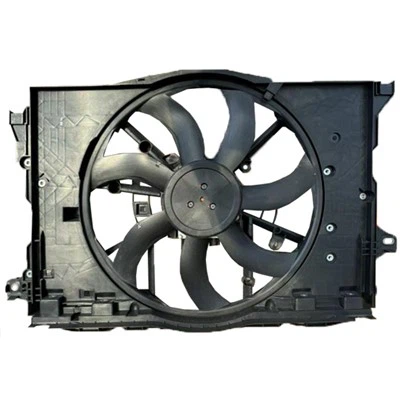
As global procurement teams prepare their sourcing strategies for 2026, China remains a key manufacturing base for automotive radiator fan assemblies. However, price dispersion in this category is wider than ever. Quotations for what appears to be the same radiator fan assembly can differ by 30–50%.
For procurement managers, the real challenge is no longer finding a low price - it is explaining why a selected price is reasonable, sustainable, and low-risk, rather than simply cheap.
This guide breaks down the true cost structure of radiator fan assemblies and explains where cost differences come from - and where they should not come from.

1. The Real Cost Structure of a Radiator Fan Assembly
A professional radiator fan assembly is not a single-cost item. It is a system composed of multiple cost drivers. Understanding these components allows procurement managers to evaluate quotations objectively.
1.1 Motor Cost: Copper vs. Copper-Clad Aluminum (CCA)
The motor is typically the largest single cost contributor.
Pure copper windings
Higher conductivity
Lower heat generation
Longer service life
Higher raw material exposure to copper price volatility
Copper-clad aluminum (CCA)
Lower raw material cost
Higher resistance
Increased heat under load
Shorter lifespan in high-temperature environments
Industry insight:
In 2025, copper prices fluctuated significantly, with peaks increasing motor BOM costs by approximately 8–12% for copper-heavy designs. Some manufacturers responded by quietly switching to CCA to keep headline prices low.
This decision does not show up in a quotation - but it shows up later in warranty claims.
1.2 Injection Molding Cost: Plastic Quality Matters
Fan blades and shrouds are usually injection-molded.
Cost differences arise from:
PA66 + glass fiber (GF30) vs recycled or low-grade plastics
Mold precision and lifespan
Wall thickness and reinforcement design
High-quality PA66-GF materials cost more but maintain dimensional stability under long-term heat exposure - critical for airflow efficiency and noise control.
1.3 PCB Control Module (If Applicable)
Modern vehicles increasingly rely on:
Variable-speed control
PWM signals
Brushless motor drivers
PCB cost varies depending on:
Component grade
EMC shielding design
Heat dissipation layout
Low-cost boards may function initially but fail under voltage fluctuation or thermal cycling - especially in hot climates.
1.4 Labor, Assembly, and Balancing
Labor cost differences between regions are narrowing, but process discipline still matters.
Key hidden cost drivers include:
Dynamic rotor balancing
Noise and vibration checks
Assembly consistency
Skipping these steps reduces cost marginally but increases downstream failure risk.
1.5 Packaging and Export Readiness
Export-oriented suppliers invest in:
Reinforced packaging
Moisture protection
Labeling compliance
These costs are small per unit but significant for long-distance shipments and claim prevention.

2. Why Some Quotes Are "Too Cheap to Be Safe"
Procurement managers frequently encounter prices that seem unbeatable. In most cases, extreme low pricing is achieved through invisible compromises, such as:
Replacing copper windings with CCA without disclosure
Using recycled plastics with inconsistent heat resistance
Eliminating dynamic balancing
Omitting EMC validation for control electronics
These shortcuts reduce upfront cost but shift risk downstream - to distributors, workshops, and ultimately the brand.
A low purchase price becomes a high total cost of ownership.
3. A Practical Checklist for Procurement Managers
When evaluating radiator fan suppliers, these five questions help separate reasonable cost optimization from dangerous cost cutting:
What type of motor winding is used - pure copper or CCA?
Are fan blades molded from PA66 + glass fiber, and at what ratio?
Has the motor or PCB passed EMC (electromagnetic compatibility) testing?
Is dynamic rotor balancing performed on every unit or batch-sampled?
What durability or thermal aging tests are conducted before shipment?
Suppliers who answer clearly and consistently usually have nothing to hide.
4. Explaining "Reasonable Low Cost" to Management
For internal reporting, procurement managers need to justify sourcing decisions beyond price.
A defensible position is not:
"This is the cheapest option."
It is:
"This price reflects optimized materials, controlled processes, and predictable long-term performance - without shifting risk into the warranty cycle."
This distinction matters increasingly as aftermarket buyers face tighter margins and higher service expectations.
5. Final Takeaway
China remains highly competitive for radiator fan assembly sourcing in 2026 - but cost leadership does not mean cost blindness.
The most successful procurement strategies focus on:
Transparency over headline pricing
Process capability over promises
Long-term reliability over short-term savings
Understanding the cost structure gives procurement managers the leverage they need - both in supplier negotiations and internal decision-making.
About Hongjiang Electric
Hongjiang Electric manufactures radiator cooling fan assemblies with a focus on OEM-structure design, controlled materials, and stable export quality. We work with professional buyers who value predictable performance and sustainable cost structures, rather than risky price compression.
If you are evaluating suppliers or benchmarking current quotations, our team is available to support technical and cost-level discussions.
👉 Contact us to review your sourcing requirements .