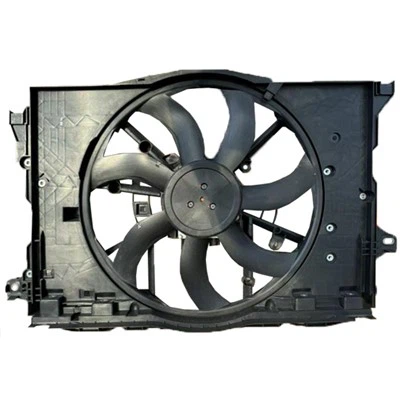
The 25380-H7000 fan assembly is designed specifically for the Kia Pegas or Kia Soluto. These two models are different market names for the same vehicle (primarily sold in China, Southeast Asia, and South America).
This kind of integrated cooling fan shroud with a built‑in coolant expansion/overflow tank (like the 25380‑H7000 style assembly) mainly benefits the OEM by higher integration, lower cost, and easier packaging, and it is not a uniquely Korean‑car feature.

Main advantages of this integrated design
- Fewer parts and simpler assembly
When the fan shroud, expansion tank, and brackets are separate, each one needs its own tooling, part number, logistics, and separate installation on the radiator or body. An integrated module can be installed as one unit on the radiator, which shortens assembly time and reduces labor and manufacturing cost.
- Better rigidity and positional accuracy
Mounting the expansion tank directly on the shroud lets engineers control tank height, angle, and hose routing together with the fan and radiator layout. The mounting points share the same plastic structure, which reduces the risk of vibration, interference with other components, or hoses being bent too sharply.

- Easier optimization of cooling and layout
The fan shroud's job is to pull air evenly through the radiator core, improving cooling efficiency. When the tank is integrated, engineers can tune airflow passages and tank placement at the same time, so they can:
- Keep the tank high enough to stay at or above the highest point of the cooling circuit for better air bleeding and stable coolant level.
- Shorten hose length and reduce tight bends, which helps flow and reduces noise and NVH.
- Cost and supply‑chain benefits
For the carmaker, one supplier delivering a complete "cooling module" (fan, motor, shroud, tank, brackets, sometimes sensors) simplifies validation testing and logistics. Warranty and service handling is also simpler, because the whole assembly can be replaced as a single module, even though that can raise replacement cost for the end customer.
Effect on cooling system function
Support for the expansion/overflow tank's role
The tank must provide enough expansion volume, sit at or near the highest point of the system, and allow trapped air to escape. Fixing it to the shroud, whose position is defined by the radiator mounts, helps keep the tank at a consistent height and angle, which supports bleeding, stable coolant level reading, and correct operation of any level sensor.
Requirements on shroud structure and material
Because the shroud now carries coolant weight and heat as well as airflow loads, it is usually made from reinforced engineering plastics (for example glass‑fiber‑reinforced nylon). The rib design is more complex to give enough stiffness so that the tank does not sag or crack and the shroud does not rub on the radiator core.
Service pros and cons
The advantage is diagnostic convenience: once the module is off the car, the fan motor, blades, shroud, and tank can all be inspected together. The downside is that a crack or leak in the tank usually means replacing the entire fan module, which is more expensive than changing a stand‑alone cheap plastic tank.

Whether this is a "Korean‑car thing"
Not exclusive to Korean brands
Integrating the expansion/overflow tank into the fan shroud or radiator module is used by European, Japanese, and American manufacturers as well, especially on compact platforms where space is tight and OEMs chase every cost and assembly‑time advantage they can get.
Why it feels common on Korean cars
Hyundai, Kia and other Korean brands have widely adopted "cooling modules" on small and mid‑size platforms, with one module combining radiator, condenser, fan assembly, shroud, and sometimes the tank. Because many Korean models visible in the market use this strategy, it easily creates the impression that it is a "Korean special," but in engineering terms it is part of a global trend toward more modular, integrated front‑end cooling packages rather than something unique to Korean OEMs.
[Reference]
[1](https://exoracing.co.uk/blog/what-is-a-fan-shroud-and-why-are-they-used/)
[2](https://www.chinatongchi.com/korean-car-parts-auto-cooling-system-replacement-parts-cooling-fan-oe-no-25380-22500-25380-22000for-hyundai-kia.html)
[3](https://www.bimmerforums.com/forum/showthread.php?2153779-Designing-an-Electric-Fan-Setup%21)
[4](https://patents.google.com/patent/CN2292165Y/zh)
[5](https://www.youtube.com/watch?v=jkhYt-OaipE)
[6](https://hx-autoparts.com/en_product_view.asp?id=5)
[7](https://www.flatironstuning.com/blog/what-does-a-coolant-expansion-tank-do-and-do-i-need-one-qotw)
[8](https://www.tf-works.com/shrouds-accessories/)
[9](https://www.facebook.com/groups/vintagemustangforum/posts/10161256180951251/)
[10](https://www.youtube.com/watch?v=zhX1pCyqnvk)